
Automotive OEM Partners

Dongfeng Mengshi M917
Jun 12, 2026
Share:
Project Overview:
The Dongfeng Mengshi 917 is the first luxury electric off-road vehicle launched by Dongfeng Mengshi Technology, officially hitting the market in August 2023. As a leading representative of China’s high-end new energy off-road vehicles, the Mengshi 917 combines military heritage, electric technology, and intelligent features to provide a higher level of driving safety in complex road conditions and extreme off-road scenarios.
To further enhance the vehicle’s perception capabilities at night and in adverse weather conditions, the Mengshi 917 comes standard across all models with the VEHIR far-infrared night vision system, making it China’s first mass-produced off-road vehicle equipped with an infrared night vision system.

Project Background and Challenges:
Off-road vehicles are typically used in complex environments, and drivers frequently encounter the following situations:
Driving on unlit roads at night
Complex terrain such as mountainous and forested areas
Low-visibility weather conditions such as dense fog, dust, and sandstorms
Pedestrians or animals suddenly entering the driving area
Standard visible-light cameras are limited by lighting conditions
In these scenarios, traditional headlights and standard cameras are easily affected by environmental factors, making it difficult for drivers to detect potential hazards in a timely manner and thereby increasing safety risks.
Therefore, the Mengshi 917 requires a perception system capable of operating around the clock, providing continuous and reliable environmental awareness even in complete darkness and under complex weather conditions.
Solution:
To meet the application requirements of the Mengshi 917, VEHIR provides an in-vehicle far-infrared night vision system solution.
Based on infrared thermal imaging technology, the system detects thermal radiation emitted by target objects, converts thermal signals into visual images, and displays them in real time on the vehicle’s instrument cluster or central control display.
Unlike traditional visible-light cameras, infrared thermal imaging technology does not rely on external light sources, enabling it to operate continuously in environments such as at night, in backlight conditions, heavy fog, or dust.
The system provides all-weather monitoring of the road ahead and identifies and issues early warnings for potential hazards.
Key System Features:
24/7 Environmental Awareness
The system operates continuously in the following conditions:
· Pitch-black environments at night
· Heavy fog
· Sandstorms
· Smoky environments
· Low-light environments
Helping drivers obtain clearer road information.
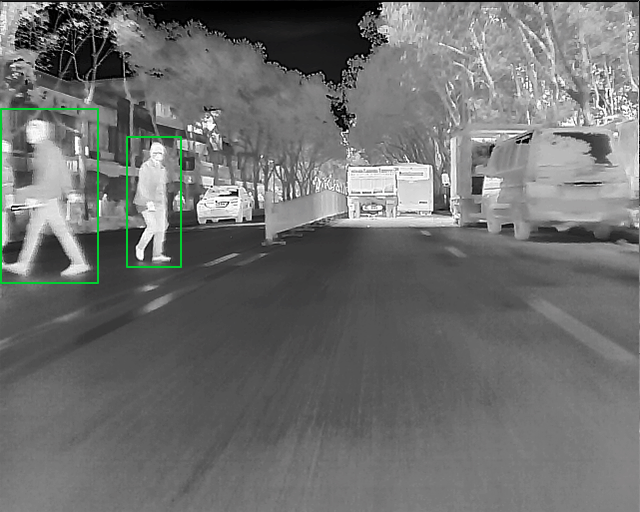
Pedestrian Recognition:
The system can automatically detect pedestrians on the road ahead.
Pedestrian detection range: 5–90 m
Pedestrian recognition accuracy: ≥95%
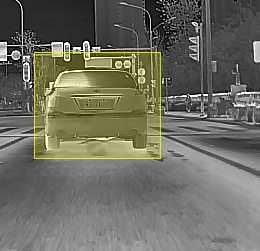
Vehicle Recognition:
The system can detect vehicles ahead and in the surrounding area.
Vehicle detection range: 5–120 m
Vehicle recognition accuracy: ≥96%
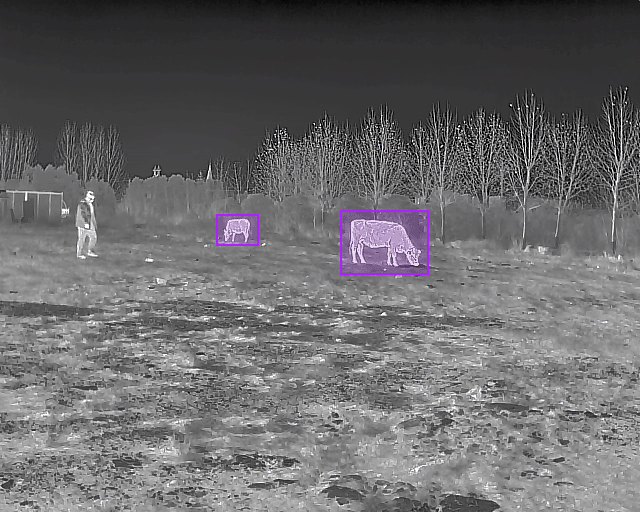
Animal Identification:
The system can detect animals near the road and issue early warnings.
Animal detection range: 5–70 meters
Animal detection accuracy: Not available
Alert:
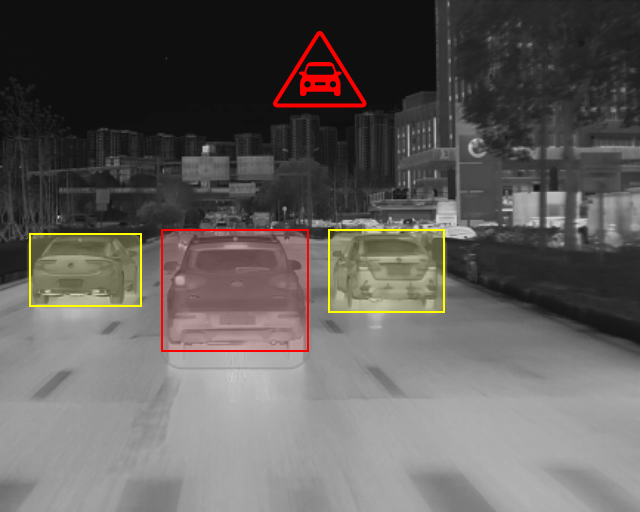
When the system detects a potentially dangerous target, it can issue a warning via the display interface.
Alert type (visual alert/audible alert)
Risk level display method:
1. When a pedestrian or cyclist appears within a 3-meter-wide area in front of the vehicle, the vehicle’s speed exceeds 25 km/h, and the TTC (Time to Collision) is ≤2.7 seconds, the pedestrian’s position is indicated by a red rectangular box, a red triangular pedestrian warning symbol is displayed, and an audible alarm is triggered.
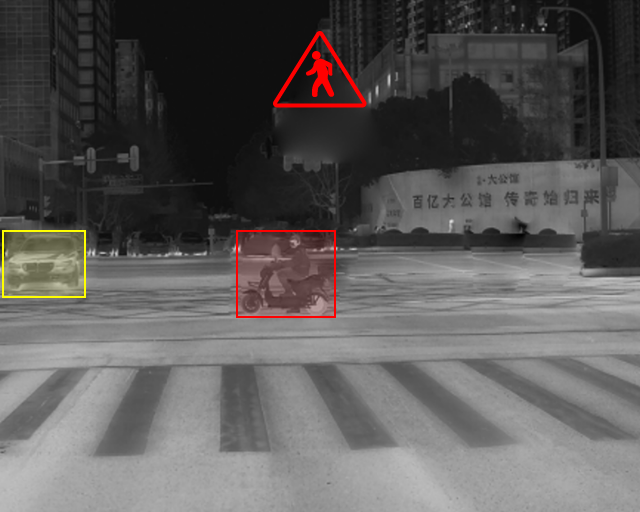
2. When a vehicle appears within a 3-meter-wide area in front of the vehicle, the vehicle’s speed exceeds 25 km/h, and the TTC collision time is ≤2.7 seconds, the vehicle’s position is indicated by a yellow rectangular box, a red triangular vehicle symbol is displayed as a warning, and an audible alarm is emitted simultaneously.
System Integration Solution:
The far-infrared night vision system has been deeply integrated with the electronic and electrical architecture of the Mengshi 917 vehicle.
Through the vehicle's display system, the driver can view real-time thermal imaging footage of the area ahead, along with target identification information.
Infrared camera mounting location: Front bumper
· Display type: Instrument cluster or center console screen
· Communication protocol: 500 kbps CAN
· System interface type: LVDS
· ECU integration: Activated via physical infrared night vision button
The application of far-infrared night vision systems has effectively enhanced vehicle safety in complex environments.
Compared to traditional visible-light solutions, the system can:
· Detect pedestrians on the road earlier
· Distinguish vehicles from obstacles more clearly
· Identify animal targets more effectively
· Expand the field of view during nighttime driving
· Improve environmental awareness in adverse weather conditions
This helps drivers obtain information about road hazards in advance, thereby reducing safety risks caused by limited visibility.
Project Outcomes:
The Mengshi 917 has become China’s first mass-produced off-road vehicle equipped with a far-infrared night vision system.
This project has fully demonstrated the value of infrared thermal imaging technology in high-end new-energy off-road vehicles, while also showcasing VEHIR’s technical expertise and engineering capabilities in the field of in-vehicle infrared sensing.
Customer Recognition:
In 2023, VEHIR was honored with the following award from Dongfeng Mengshi Technology for its outstanding performance on the Mengshi 917 project:
“Fearless Conqueror Award”
This award reflects the client’s recognition of VEHIR’s product performance, project delivery capabilities, and technical service capabilities.
Project Highlights:
• China’s first mass-produced off-road vehicle equipped with an infrared night vision system
• All-weather thermal imaging capabilities
• Designed for use in complex environments such as at night, in fog, and during sandstorms
• Supports the detection of pedestrians, vehicles, and animals
• Deeply integrated with the vehicle’s electronic architecture
• Enhances driving safety and the intelligent driving experience
Dedicated to the development of global in vehicle infrared technology
If you would like to learn more about safe driving solutions, please contact us
News


