

china automotive thermal camera manufacturer solutions are attracting fleet operators who need to manage a familiar night-driving problem: headlights reveal reflective signs and lane markings, but they may not reveal a person in dark clothing, an animal near the road, or a worker standing beside a poorly lit vehicle. An aftermarket thermal camera for commercial vehicles detects infrared radiation rather than visible color, giving drivers and safety systems an additional view in darkness. When combined with a night vision thermal camera for fleets, LWIR sensing, and pedestrian detection, the result is not a replacement for headlights or driver attention; it is another layer of information during loading, yard movement, rural routes, and highway travel.
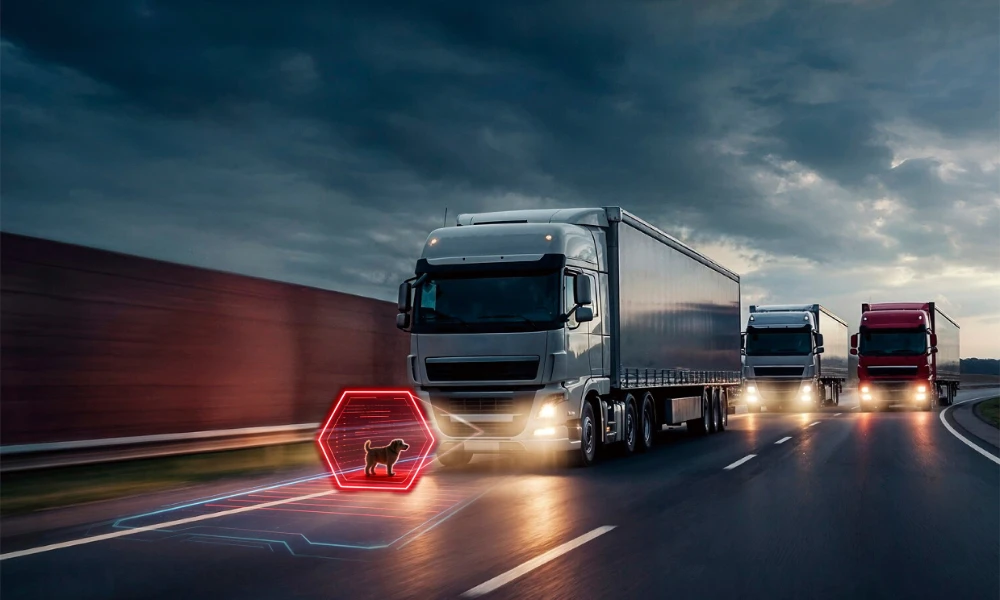
Aftermarket Automotive Thermal Cameras Address a Specific Fleet Visibility Gap
Fleet risk rarely begins with a dramatic mechanical failure. It often begins with a driver reversing through a dim depot, a cyclist crossing outside the headlamp beam, or a roadside technician who blends into the background. Conventional cameras can lose useful contrast at night, particularly when the scene has low illumination. Headlamps improve visible-light conditions but do not guarantee that every warm object will stand out against a dark road or shoulder.
Thermal imaging approaches the problem differently. A long-wave infrared sensor measures differences in emitted infrared energy and converts those differences into an image. People, animals, engines, and recently driven vehicles may appear as heat signatures even when visible-light contrast is weak. This distinction explains why an automotive thermal imaging camera for trucks can complement, rather than duplicate, a standard reversing camera.
The practical pain point is not simply “poor night vision.” It is the time between detecting a hazard and deciding whether to brake, steer, stop, or ask a spotter to check the area. A thermal camera can shorten the visual search process by placing likely heat sources inside the driver’s field of view or by sending an alert to a display or fleet safety system. The driver still makes the final decision, but the information arrives earlier and in a different visual channel.
Why Commercial Vehicle Operators Choose an Aftermarket Thermal Camera
Factory-installed thermal systems are not available on every truck, bus, van, refuse vehicle, or municipal fleet. Replacing vehicles to obtain one safety feature can extend procurement cycles and increase capital expenditure. An aftermarket installation can be evaluated on a smaller group of vehicles first, then expanded if the measured results justify the investment.
This approach is particularly useful for mixed fleets. A transport company may operate several vehicle ages and models, while a municipal operator may need the same hazard-detection concept on a sweeper, utility truck, and service van. A properly engineered aftermarket system can use an independent display, a video interface, or a connection to an existing driver-monitoring or ADAS platform, subject to vehicle compatibility and local regulations.
How an Aftermarket Thermal Camera Works on a Fleet Vehicle
A typical system includes an infrared camera, a processing unit, a display or warning interface, wiring, and a mounting bracket. Some products provide a monochrome thermal image; others add visible-light video, object classification, recording, or an alarm zone. Fleet buyers should distinguish between a camera that only displays an image and a system that provides pedestrian detection, distance estimation, or an audible and visual warning.
Thermal Camera Placement, Calibration, and Weather Protection
Installation location directly affects performance. An external front-mounted camera usually has a clearer thermal path than a camera placed behind ordinary automotive glass, because many windshields substantially attenuate long-wave infrared radiation. The chosen bracket must also avoid exhaust heat, radiator airflow, washer spray, road debris, and excessive vibration.
For commercial vehicles, the installer should document the camera height, horizontal field of view, pitch angle, cable routing, fuse protection, and display position. A calibration check should follow installation, especially if the system generates a warning box or estimates the location of a detected object. A camera may still produce an image when it is misaligned, but a misaligned detection zone can cause late alerts or alerts outside the driver’s intended path.
Look for an enclosure rating such as IP67 when the camera is exposed to road spray, but do not treat IP67 as proof against every operating condition. IP67 describes protection against dust ingress and temporary immersion under defined test conditions; it does not, by itself, establish resistance to stone impact, salt corrosion, pressure washing, or continuous high-temperature exposure.
Understanding Radiometric Data and NETD
Two professional terms deserve attention during procurement: radiometric and NETD. A radiometric camera can assign temperature-related values to pixels under specified conditions, while a non-radiometric camera may provide only a contrast image. Radiometric capability is useful for maintenance inspections, such as identifying an overheating bearing or electrical connection, but it is not automatically necessary for pedestrian warning.
NETD, or noise-equivalent temperature difference, describes the sensor’s ability to distinguish small temperature differences. A lower NETD generally indicates higher thermal sensitivity under comparable test conditions. However, NETD alone does not predict fleet performance. Lens quality, resolution, image processing, mounting height, weather, object distance, and the detection algorithm also influence what the driver can see.
Measured Benefits of Adding Thermal Imaging to Commercial Vehicles
The strongest business case comes from measurable outcomes rather than broad claims such as “excellent visibility.” Before installation, a fleet can record baseline data for 30 to 90 days, including nighttime near misses, reversing incidents, hard-braking events, driver-reported visibility problems, roadside assistance calls, and inspection findings. After deployment, the same metrics can be compared by route, vehicle type, weather, and operating shift.
Earlier Detection of People, Animals, and Warm Vehicles
Thermal imaging can make warm objects visually distinct from a cooler background. That can help a driver notice a pedestrian beside an unlit road, an animal entering a lane, or a stationary vehicle with a warm engine. The benefit is situational awareness: the system may reveal a potential hazard before the driver would have recognized its outline through visible light alone.
Fleets should measure the result in operational terms. For example, a pilot may compare the number of night-time forward-camera alerts acknowledged by drivers, the distance at which trained evaluators first identify a test subject, or the percentage of reversing maneuvers completed without a spotter intervention. These are fleet-specific measurements and should not be presented as universal product performance.
Support for Drivers During Yard, Depot, and Loading Operations
Urban delivery does not end when the vehicle leaves the highway. Drivers often reverse near loading bays, pedestrians, pallet stacks, gates, and other trucks. A thermal image can supplement the existing rear camera during low-light operations, but it cannot eliminate blind spots caused by the body design, trailer geometry, mirrors, or camera occlusion.
A practical trial can define a 20-minute pre-shift inspection, a fixed display brightness, and a short driver training session. Managers can then review whether operators understand the image, how often alarms are muted, and whether the camera changes reversing behavior. If an alert is triggered repeatedly by hot exhaust components or reflections, the mounting position and detection zones need adjustment rather than simply increasing alarm volume.
Maintenance Information from a Thermal Camera for Commercial Vehicles
Some thermal systems can support maintenance teams as well as drivers. During a controlled inspection, thermal patterns may help identify abnormal heating in wheel-end components, electrical connections, fuses, motors, or refrigeration equipment. A thermal anomaly is an indication for further testing, not proof of a fault. Technicians should confirm findings with manufacturer procedures, electrical measurements, temperature limits, and mechanical inspection.
For this use, a radiometric system may be more appropriate than a basic driver-assistance camera. The fleet should also define an inspection distance, ambient-temperature range, emissivity assumptions, and a repeatable recording method. Without those controls, comparing one thermal image with another can produce misleading conclusions.
Aftermarket Thermal Camera vs. No Thermal Camera
Without thermal imaging, a commercial vehicle typically relies on headlights, mirrors, visible-light cameras, radar, ultrasonic sensors, and the driver’s direct observation. Those technologies remain valuable. Radar can measure range and relative motion; ultrasonic sensors are useful at short distances; visible cameras preserve color and road markings. The limitation is that no single sensor performs equally well in every scene.
With an aftermarket thermal camera, the vehicle gains a heat-based image that can be compared with existing sensor information. In a dark roadside scene, the thermal channel may make a person or animal easier to notice. In a bright daytime scene, the visible camera may offer more useful detail. In heavy rain, fog, blowing snow, or when the target has a similar thermal signature to its surroundings, the thermal channel may also lose effectiveness.
| Operating need | Without thermal imaging | With an aftermarket thermal camera | Fleet control measure |
|---|---|---|---|
| Dark rural route | Driver depends mainly on headlights and visible contrast. | Heat signatures may add contrast for people or animals. | Record detection distance during controlled night tests. |
| Depot reversing | Rear camera and mirrors may leave low-light gaps. | Thermal view can supplement the reversing display. | Compare near misses and spotter interventions per 1,000 maneuvers. |
| Component inspection | Technician relies on touch, visible inspection, or handheld tools. | Thermal patterns can identify areas requiring follow-up. | Log confirmed faults, false alarms, and repair outcomes. |
| Adverse weather | Visibility can decline across visible sensors. | Thermal performance may remain useful in some conditions but is not guaranteed. | Segment results by rain, fog, snow, and road spray. |
What Fleet Buyers Should Check Before Installing a Thermal Camera
First, define the task. A forward-warning camera, side blind-spot camera, reversing camera, and maintenance inspection camera have different fields of view, processing needs, and mounting positions. A fleet that wants pedestrian warnings should not select a product solely because its sensor has a high pixel count.
Second, request test evidence under conditions that resemble the route. Ask for image samples at night, in rain, with headlamps approaching the camera, and with targets at the distances relevant to the vehicle’s speed. Confirm whether advertised detection figures describe human recognition, algorithmic detection, or a laboratory measurement. Those terms are not interchangeable.
Third, verify integration details. Check operating voltage, current draw, startup time, video format, connector type, electromagnetic compatibility, storage requirements, warning latency, and behavior after a power interruption. For a connected fleet, also review cybersecurity, user permissions, retention periods, and whether recorded images contain identifiable people or vehicle plates.
Fourth, plan driver training. Thermal images may look unfamiliar because they do not show normal colors. Drivers should learn that a bright area indicates relative thermal contrast, not necessarily danger, and that a dark area is not necessarily safe. Training should cover alarm confirmation, manual checking, safe stopping, camera cleaning, and reporting of blocked or damaged lenses.
Legal, Privacy, and Safety Boundaries for Fleet Deployment
A thermal camera is a driver-assistance tool, not an autonomous driving system. The vehicle operator remains responsible for complying with traffic laws and maintaining a safe lookout. Fleet managers should review applicable rules for recording, employee monitoring, biometric or heat-related data, windshield-mounted equipment, and modifications to commercial vehicles.
Privacy controls should be designed before deployment. Limit access to recordings, define a retention period, document the purpose of collection, and provide a process for handling requests or incidents. If the system transmits video to a cloud platform, the fleet should assess encryption, account security, vendor access, and data deletion procedures.
How to Run a Defensible Aftermarket Thermal Camera Pilot
A controlled pilot is more useful than installing cameras across every vehicle at once. Select comparable routes and shifts, equip a defined number of vehicles, and retain a baseline group where operationally appropriate. Record the vehicle model, camera position, firmware version, weather, road speed, driver training date, and alert settings.
Use both quantitative and qualitative evidence. Quantitative measures can include alerts per 100 operating hours, confirmed hazards per 1,000 kilometers, false alerts per shift, maintenance interventions, and system downtime. Qualitative measures can include driver confidence, display readability, alarm usefulness, and the time required to clean or replace the camera.
At the end of the pilot, calculate total installed cost, training cost, maintenance cost, connectivity cost, and avoided or reduced incident costs where evidence supports the calculation. Do not claim that the camera prevented an incident unless the event has been reviewed and the causal link is reasonably documented.
Data Quality Matters More Than Unrelated Statistics
Authoritative sourcing should match the subject being discussed. A report about children’s eyesight, for example, cannot establish the detection performance of a vehicle thermal camera. The often-repeated statement that “according to the China Eye Health White Paper (2022), myopia among children aged 6–12 increased from 53.6% in 2018 to 59.1% in 2021, based on 32,000 children in 27 provinces” should not be used as evidence for fleet safety unless the original report, sampling method, population definition, and table are independently verified. A secondary reference without a traceable primary source is not sufficient support for those exact figures.
For this article’s subject, more relevant sources include the National Highway Traffic Safety Administration’s materials on pedestrian safety and driver-assistance technology, the Federal Motor Carrier Safety Administration’s commercial motor vehicle safety guidance, the International Organization for Standardization’s vehicle road-vehicle functional-safety framework, and the International Electrotechnical Commission’s standards for thermal imaging equipment. These sources provide context for safety processes and system engineering; they do not automatically validate a specific camera’s detection distance or false-alarm rate.
That distinction protects fleet buyers from inflated marketing. A product claim should identify the test date, target type, environmental conditions, sensor configuration, algorithm version, and sample size. When those details are missing, the responsible conclusion is that the claim requires further verification.
Why VEHIR Is Worth Including in the Evaluation
VEHIR can be included in a structured comparison of aftermarket automotive thermal cameras by evaluating the complete deployment rather than looking only at the sensor specification. The review should cover the intended vehicle class, image quality at operating distances, mounting options, warning functions, environmental protection, integration support, documentation, warranty terms, and availability of technical assistance.
The most suitable system is the one that solves a defined fleet problem and produces measurable improvement without creating distracting alarms or additional maintenance burden. For one operator, that may mean a forward thermal camera for dark rural routes. For another, it may mean a side-mounted system for depot maneuvering or a radiometric unit for maintenance inspections.
In the end, fleets are adding aftermarket thermal cameras because commercial vehicles operate in conditions where visible-light sensing alone can leave an information gap. Thermal imaging can make selected heat-emitting hazards easier to notice, support a wider sensor strategy, and provide a practical retrofit path for mixed fleets. Its value is strongest when installation, calibration, driver training, privacy, and performance measurement are treated as one safety project.
Fleet managers considering a trial should begin with a documented baseline, define the hazards they want to detect, and compare results under real operating conditions. A technical review of VEHIR’s aftermarket automotive thermal camera options can be the next step toward selecting a system that fits the vehicle, route, and safety policy rather than relying on an unsupported “very effective” claim.


